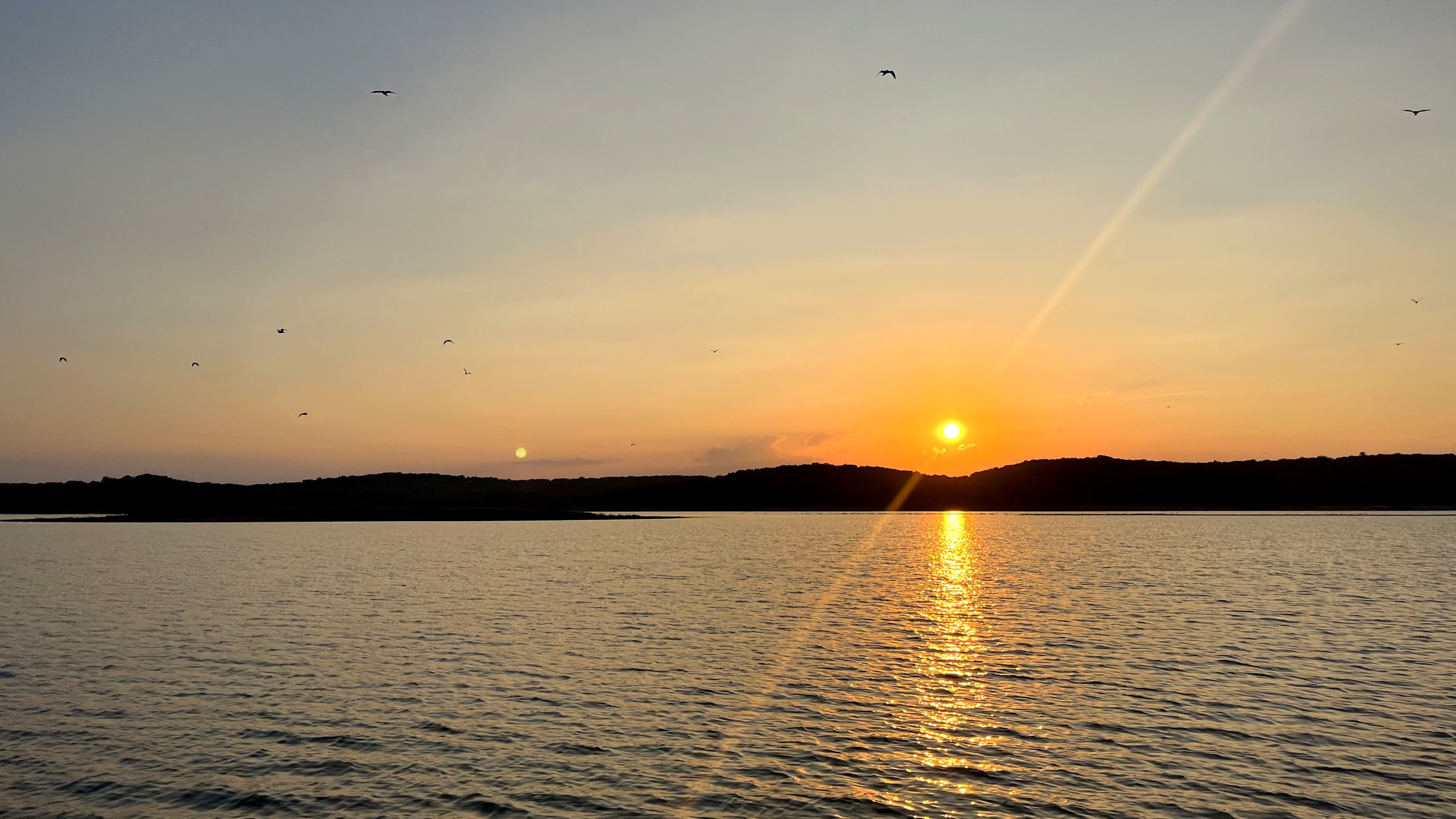
By late June, Truman Lake's surface temps climb past 80°F and stay there through August. The fish don't disappear — they relocate. Knowing where they go is the difference between a cooler full of fillets and a long, sweaty boat ride home.
Summer at Truman rewards anglers who adjust. Early mornings, deep water, and night trips replace the shallow-cove patterns that work so well in spring. Here's what to target and where.
White Bass and Hybrid Striper Boils
Some of the most exciting fishing Truman Lake offers happens in full summer daylight — for about 20 minutes. When shad schools migrate toward the surface at dawn and dusk, white bass and hybrid stripers push them up from below. The result is a boil: a churning patch of water that looks like it's raining fish.
Main lake points, wide creek mouths, and the Sterett Creek arm are consistent spots. You'll often see birds working the surface before you see the fish. Run toward the birds.
When a boil pops up, match what the fish are eating:
- Slabs (chrome, 1/2 to 3/4 oz) — cast past the boil and retrieve fast through it
- In-line spinners (silver blade, 1/4 to 3/8 oz) — simple and effective
- Walking topwater baits — if the boil is slow-rolling and the fish aren't spooked
Boils are unpredictable and can shut down in seconds. Have your rods rigged and ready before you get there. Don't idle into the school — cut the big motor early and drift or use your trolling motor from the edge.
Hybrid stripers are a separate story worth chasing on their own. Guides on Truman specifically target hybrids in summer, often trolling umbrella rigs or large swimbaits along main lake structure. Fish over 10 lbs are realistic on Truman — these aren't throwbacks.
Catfish Peak in the Heat
Hot weather is catfish weather. Channel cats, blue cats, and flatheads all feed aggressively through July and August, making this the best time of year for anyone targeting big fish from the bank or a slow-drifting boat.
The Osage River channel and Grand River channel hold good numbers of channel and blue cats. Below the dam at Warsaw is a consistent producer for blue cats, especially after generation — when the turbines run, baitfish concentrate and the big cats follow.
Bait matters by species:
- Channel cats: cut shad and chicken liver both work. Fresh-cut shad edges out liver when shad are abundant.
- Blue cats: cut shad fished on the bottom in river channel bends. Bigger bait, bigger fish.
- Flatheads: live bluegill is the standard. Flatheads are ambush predators — anchor near submerged timber and let the bait do the work.
Flathead fishing peaks after dark. Set up near a log jam or a deep creek channel junction, put out a big live bait on the bottom, and wait. Flatheads in Truman can push past 40 lbs.
For current conditions on bait and where catfish are moving, check our Truman Lake fishing report — it's updated seasonally.
Deep Crappie on Brushpiles
Crappie don't stop biting in summer — they just drop. Fish that were suspended at 8-10 feet in May are sitting at 18-25 feet by July, usually parked on brushpiles, submerged timber, or any structure that offers shade and cooler water.
Vertical jigging is the move. Drop a 1/16 or 1/8 oz tube jig or curly-tail grimp straight down through the fish column and work it slowly. If you have access to a LiveScope or similar forward-facing sonar, summer is when it earns its price — you can see exactly which depth the fish are holding and keep your jig in the zone.
The Tebo arm near Osceola holds brushpiles that see less pressure than the north-lake areas around Warsaw. If you're staying on the south end, those deep coves are worth exploring. Osceola-side structure tends to warm more slowly in spring but holds cooler pockets in summer, which concentrates fish.
Patience pays. Summer crappie are lethargic — a slow presentation consistently beats speed.
Largemouth Bass: Early, Late, or Not at All
Full midday sun with surface temps at 84°F is not largemouth bass habitat. They're in the lake — pressed tight to deep brush, sitting on main lake points with access to 15+ feet of water, or hiding under mats of floating vegetation near the shoreline.
The window is real but short: first light until about 8 AM, and again from an hour before sunset through dark. During those windows, fish are willing to eat topwater baits near the bank, especially along shaded shorelines or near laydowns.
During the day, if you're committed to bass fishing, go deep. Carolina-rigged soft plastics dragged slowly across main lake structure, or a football jig worked through submerged brush at 15-20 feet, can still produce. Drop shots work near vertical structure.
Skip the shallow, sun-baked coves between 9 AM and 5 PM. You'll burn fuel and time for nothing.
Night Fishing at the Marina Lights
This is summer fishing's best-kept advantage. Several marinas on Truman Lake leave dock lights on overnight, and those lights concentrate shad — and everything that eats shad.
Long Shoal Marina, Sterett Creek Marina, and Bucksaw Marina all offer access to lit structures after dark. Crappie, white bass, and largemouth all stack under marina lights on summer nights. A small tube jig or a 1/16 oz jighead with a 2-inch paddle tail, fished under the light cone where it meets the dark water, is a reliable setup.
Night fishing also solves the boat traffic problem. Truman on a July Saturday afternoon is crowded — jet skis, pontoons, and tournament boats all competing for space. Being on the water at 10 PM on that same Saturday is a completely different experience.
If you're renting a cabin on the lake, night fishing from the dock (if your property has dock access or a slip) is one of the underrated pleasures of a Truman Lake summer trip. Check our cabin listings for properties with dock access or private fishing piers.
Weekday vs. Weekend — It Matters
Truman Lake draws heavily from Kansas City (roughly 2 hours) and Springfield (roughly 1.5 hours), and summer weekends show it. By 9 AM on a Saturday, the main lake near Warsaw and the Sterett Creek area will have consistent boat traffic that scatters fish and makes tournament-style bank fishing difficult.
If your schedule allows, mid-week visits cut the crowd noticeably. Alternatively, commit to pre-dawn starts — being on a productive point at 5 AM on a Saturday, before the pleasure boats launch, gives you the best of both worlds.
Tournament weekends also concentrate fishing pressure in specific areas. Check the events calendar before you go so you know what's running.
Staying Safe on the Summer Lake
The sun on open water is more intense than most people expect. Lake reflection doubles your UV exposure, and dehydration sneaks up fast when you're focused on fishing.
A few things worth stating plainly:
- Polarized sunglasses aren't optional in summer — they cut glare and let you read the water surface for structure and boils
- Sunscreen applied early and reapplied every two hours; SPF 50+ on the hands, face, and neck
- Water: bring more than you think you need — a cooler with ice water beats anything in a soft bag sitting in the sun
- Life jackets: always on for anyone under 7, always accessible for everyone else
If you're fishing midday and it's 95°F, it's worth ducking into a cove with shade or heading back to the cabin for a few hours. The fishing will improve again by late afternoon.
What to Skip in Summer
A few patterns that work well in spring are mostly a waste of time in July and August:
- Shallow brush in midday: unless you're targeting bass in vegetated mats, fish aren't sitting in 3 feet of 85°F water
- Crappie at spring depths: if you're fishing the same 8-foot brushpile you crushed in April, you'll wonder where the fish went. They went deeper.
- Topwater bass mid-morning: the window closes fast once the sun gets up. A walking bait at 10 AM in July is a long shot.
Summer at Truman rewards anglers who adapt. The fish are still there — and some of the biggest catfish and hybrid stripers of the year come in August.
Plan Your Summer Trip
For up-to-date conditions on what's biting and where, our Truman Lake fishing report is the quickest way to get current intel before you launch. If you're looking at guided hybrid striper or catfish trips, several local guides operate out of Warsaw and Osceola.
Need a place to stay? Browse Truman Lake cabin rentals — owner-direct listings mean no service fees, and you'll talk directly to someone who fishes the lake and knows where the brushpiles are.