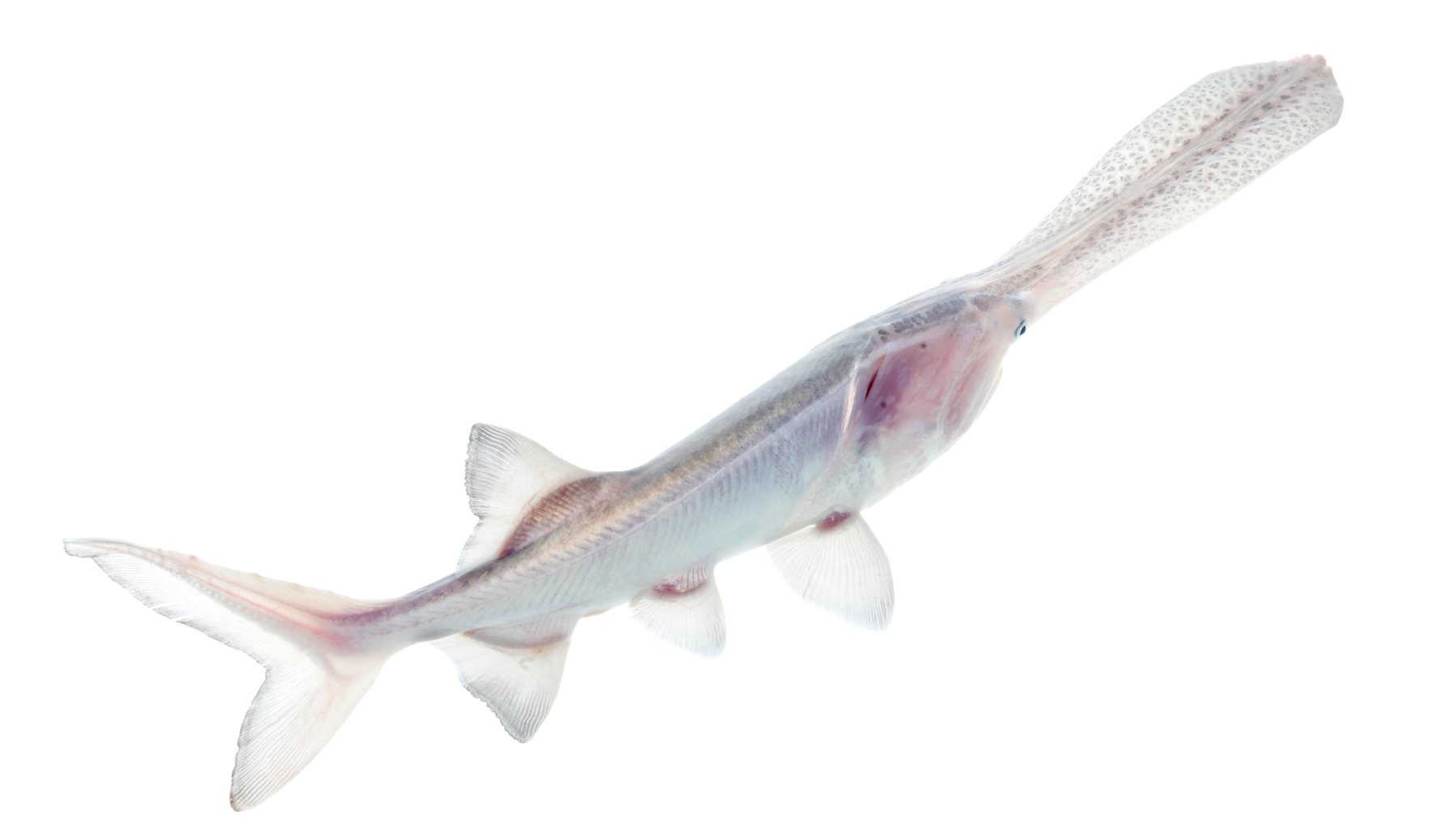
Paddlefish have been swimming Missouri rivers for roughly 300 million years, and every spring a short six-week window opens up at Truman Lake that lets you legally snag one. We're talking a fish that can top 80 pounds, looks like something out of a fossil record, and puts up a fight heavy enough to buckle your knees on a river bank. If you've never tried paddlefish snagging before, Truman Lake is one of the best places in Missouri to start.
What Paddlefish Actually Are
Paddlefish (Polyodon spathula) are not your typical sport fish. They're filter feeders — they cruise open water with their mouths agape, straining zooplankton through gill rakers. That long, paddle-shaped rostrum (the bill) can make up a third of the fish's total body length and is packed with electroreceptors that help them detect concentrations of plankton.
Because they don't chase bait, you can't catch them on a lure or a hook baited with a worm. Instead, you snag them — casting a large weighted treble hook into the current and sweeping it through the water column until it connects with a fish. It sounds simple, and the technique is, but landing a 40-pound paddlefish in fast tailwater current is its own education.
Most fish you'll encounter at Truman run 20–50 pounds. True giants pushing 80+ lbs show up every season, though they're the exception. Either way, plan on a serious upper-body workout.
Season, Limits, and Licensing
Missouri's paddlefish snagging season at Truman Lake runs March 15 through April 30. That's it — six weeks, no exceptions. The season aligns with the spring congregation of fish in tailwater areas below the dam, where current and warming water pull paddlefish in from across the reservoir.
Daily limit: 2 paddlefish per angler, per day. Possession limit is also 2.
To legally snag at Truman, you need two things:
1. A valid Missouri fishing license
2. A paddlefish permit — $11 for Missouri residents, available at most sporting goods retailers and through the MDC's online portal
Non-residents are not eligible to participate in the snagging season under current Missouri regulations. Always verify current rules directly with the Missouri Department of Conservation before you go — regulations do occasionally change between seasons.
You must also have a paddlefish tag attached to the fish immediately upon landing, before it leaves the water. Keep your permit and tag on your person.
Where to Snag: The Osage Tailwater and Beyond
The primary snagging location at Truman Lake is the Osage River tailwater below Truman Dam, just outside Warsaw on the eastern end of the lake. When the Army Corps of Engineers releases water through the dam, that current concentrates paddlefish in a relatively compact stretch of river — which is exactly what makes this spot so productive.
The stretch directly below the dam apron sees the heaviest pressure and, typically, the highest fish counts. Bank anglers stack up along the rocky shoreline; boat anglers anchor or drift just downstream.
You can also find snagging action on the Sac River arm, where the river enters the upper reservoir. Fish will stage here in good numbers during peak spring weeks, though the crowd is usually lighter than directly below the dam.
A few practical notes on location:
- Dam discharge affects everything. Higher discharge = faster current = heavier weights needed. Check the Corps' water release schedule at nwk.usace.army.mil before you head out.
- Early morning tends to be the most productive window, though fish move throughout the day.
- Don't wade out farther than you're comfortable — tailwater current is deceptively powerful.
Launch Ramps and Access Points
Three access points are worth knowing for a Truman Dam paddlefish trip:
Below the Dam (Corps access): There's a parking area and bank fishing access on the tailwater side of Truman Dam. No formal boat ramp here, but bank anglers have plenty of room to spread out along the rocky shoreline.
Truman Lake State Park (Warsaw): The state park on the northeast side of the lake has a boat ramp and access road that puts you close to the dam area. It's one of the better-maintained launches on the east end.
Riverview Park (Warsaw): The city of Warsaw maintains Riverview Park with a public boat ramp on the Osage arm. It's a solid option if the state park ramp is crowded, which it can be during peak paddlefish weeks.
Warsaw itself is the closest town to the dam and has gas stations, a couple of restaurants, and basic gear if you forgot something. Plan to arrive early on spring weekends — parking fills up.
Gear Setup for Beginners
You don't need a lot of specialized equipment, but the gear matters. Here's what works:
Rod: A heavy-action rod in the 8–9 foot range gives you the casting distance and sweep leverage you need. Many dedicated paddlefish snaggers use heavy catfish or surf rods.
Reel: A baitcasting or heavy spinning reel with a solid drag system. You will test it.
Line: 80–100 lb braided line. Don't go lighter — paddlefish near a dam, with current pushing them, will find every weak point in your setup.
Hook: A 6/0 to 10/0 weighted treble hook is standard. Some anglers add a 1–3 oz egg sinker above the hook depending on current speed; heavier current calls for more weight to get the hook down into the strike zone.
Leader: A short (12–18 inch) heavy monofilament or fluorocarbon leader between your braid and treble can reduce abrasion on rocky bottoms.
Bring a large net — a 24-inch or bigger landing net makes boating a 40-pound fish significantly easier. A cooler with ice is non-negotiable if you plan to keep fish.
The Snagging Technique
The basic motion is simple: cast across the current at roughly a 45-degree upstream angle, let the hook sink to the middle or lower water column, then sweep your rod upstream in a long arc and drag the hook back downstream. You're covering water, not waiting for a bite.
When you connect with a paddlefish, you'll know it immediately — the rod loads up hard and fast. Your first instinct will be to horse the fish in. Don't. Set the hook with a firm, steady pull, keep the rod tip high, and let your drag do some work. Paddlefish don't jump, but they bulldoze. A big fish in tailwater current is a sustained, grinding fight.
Common beginner mistakes:
- Sweeping too fast. A slow, deliberate sweep covers more water.
- Not varying depth. If you're not getting contact, adjust your weight or let the hook sink longer before the sweep.
- Rushing the landing. When a fish is tired but not finished, it will make one more run. Be ready.
Cleaning and the Roe
Paddlefish are skinned, not scaled — they have smooth, scaleless skin with a cartilaginous skeleton (they're related to sturgeon). Most people fillet the large muscle sections from the tail and back. The meat is firm, mildly flavored, and holds up well on a grill or in a smoker.
Here's something beginners often don't know: the roe from a female paddlefish is technically caviar. It's dark gray to black, fine-grained, and has genuine market value. Many anglers who keep hens will carefully harvest the roe before cleaning the rest of the fish. It can be rinsed and lightly salted for home use. Don't throw it away — you just caught one of the only legal sources of domestic caviar in the country.
Pair the Trip with a Cabin Stay
The paddlefish window is short, which means most anglers who drive in from Kansas City (~2 hours) or Springfield (~1.5 hours) end up doing a quick day trip. But staying a night or two near the lake makes more sense if you want to fish the best morning tides on back-to-back days — or combine the trip with the strong white bass and walleye action that also runs in the Osage tailwater during spring.
Check our Truman Lake cabin listings for options near the Warsaw and Osceola areas. Owner-direct rentals mean you're talking to the person who actually owns the property, not a call center — useful when you want to ask whether a dock can hold a 17-foot boat or whether cleaning stations are available on-site.
During snagging season, our fishing report is updated regularly with current conditions, discharge levels, and angler reports from the tailwater. Worth checking the night before you head out.
Before You Go
A few final checklist items:
- [ ] Missouri fishing license (if you don't have one)
- [ ] Paddlefish permit ($11 resident) + tag attached to your person
- [ ] Check current discharge levels at the dam
- [ ] Ice in the cooler before you leave
- [ ] Landing net (bigger than you think you need)
- [ ] Verify current MDC regulations at mdc.mo.gov
Paddlefish snagging is one of those Missouri fishing experiences that feels genuinely singular — an ancient fish, a short season, a specific stretch of moving water. Show up prepared and it's hard to have a bad time, even if the fish don't cooperate on day one.